Public Private Partnerships Amplify Pacific Small Island Climate Diplomacy

Vanuatu has unfortunately emerged as a poster child for the adverse impacts of climate change. It has been ranked over and over as one of the most vulnerable countries on the planet to the effects of climate change and disasters, and is hit annually by severe tropical cyclones, extreme flooding, prolonged drought, climate-exacerbated pest and disease outbreaks, sea level rise, ocean acidification and of course the fossil fuel driven warming that is causing loss and livelihoods and lives all around the planet.
But Vanuatu isn’t playing the victim, and has stepped out on the international stage to lead the fight for action, real solutions and climate justice. In the last few years, it has
- led International Court of Justice case on climate obligations
- made a formal proposal to include Ecocide in the crimes prosecuted by the International Criminal Court
- made the first request for assistance to the new UN Santiago Network on Loss & Damage
- spearheaded the Pacific leaders’ decision for a Fossil Fuel Free Pacific
- is leading efforts to negotiate a new Fossil Fuel Non-Proliferation Treaty to make up for the gaps in the current multilateral climate regime
Unlike in other parts of the world, where the private sector is seen as a part of the problem, emitting greenhouse gasses and seeking profit over planet, in Vanuatu the private sector is an integral part of the solution space, and has been a member of the core team in Vanuatu’s international climate diplomacy efforts.
The Vanuatu Business Resilience Council (VBRC) was initially established in 2017 as a standing committee of the Vanuatu Chamber of Commerce and Industry (VCCI), to fully engage all of Vanuatu’s private sector actors so the work they were already doing to address climate and disaster risk would be acknowledged. The initiative was so successful that the Council was given a full board seat on the Vanuatu government’s supreme climate decision making body, the National Advisory Board (NAB) on Climate Change & Disaster Risk Reduction.
“The National Advisory Board aims to provide the most inclusive and expert-guided decision-making to Vanuatu’s climate policy and programming, and the value the private sector continues to bring to climate governance is indisputable.”
Mrs Leana William, NAB Secretariat, Government of Vanuatu
In 2024, the VRBC rose to new heights in its efforts to support Vanuatu, when in June it was invited not only to negotiate on behalf of the government at the UNFCCC’s intersessionals, but also to lead Vanuatu’s efforts to co-host the Climate & Development Ministerial. More than 30 government officials, private sector leaders, and civil society champions convened at the renown Wilton Park complex in the United Kingdom to chart a new way forward on programmatic adaptation approaches. The result of the VBRC engagement at this event was a high-level Ministerial meeting in October with ministers from more than 40 countries who agreed to apply increased finance, better efficiency, and national systems at the heart of their adaptation support for SIDS and LDCs.
“It was heartening to see how much the private sector was able to bring to the climate adaptation space that has typically been reserved for governments and NGOs. We proved that the private sector is much more than just emissions reductions and finance – we are also leaders in innovating and implementing adaptation initiatives in some of the most remote and vulnerable island communities. Our ideas were a breath of fresh air to the adaptation donors who demand value for money, and business-like approaches to on-ground impact monitoring.”
Glen Craig, former Chairman, Vanuatu Business Resilience Council
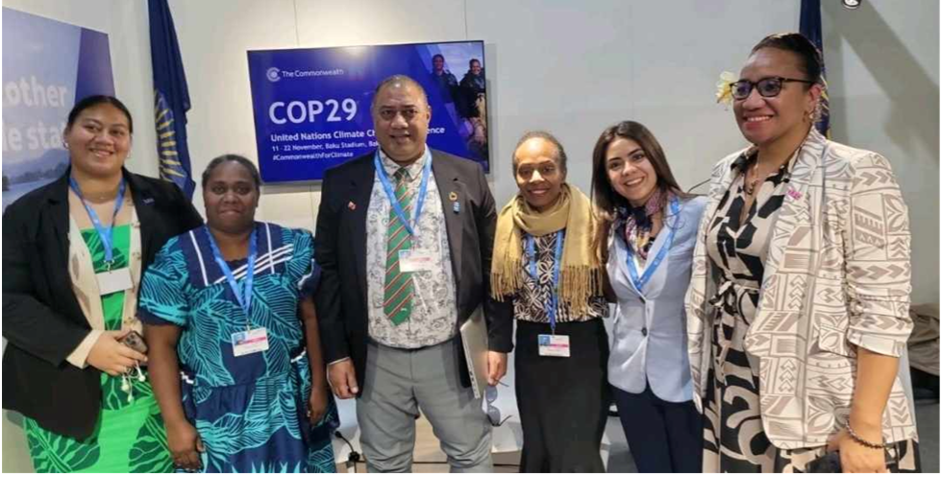
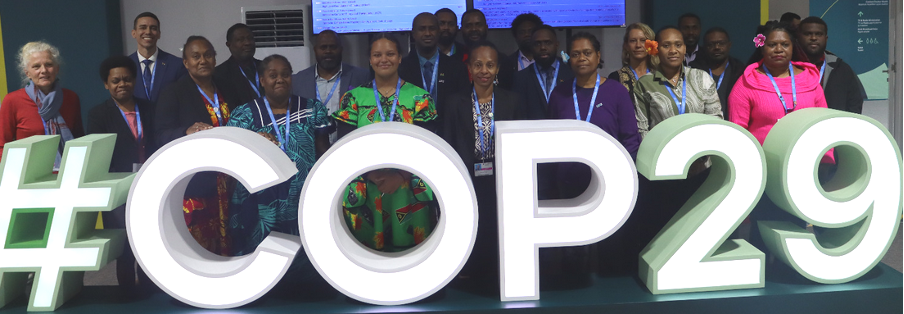
At COP29, Vanuatu’s private sector representatives were integral to negotiating the New Collective Quantified Goal on climate finance, which will see billions of US dollars flow to countries like Vanuatu.
The outcome of COP29 recognises that climate finance flows must now grow with the increasing climate impacts being experienced in communities of small island developing states and other vulnerable countries.
Dr Rebecca Bogiri and long-time coordinator of the VBRC
Climate and Disaster Finance gaps were hammered home when the VBRC and private sector were left to foot the bill for the damages caused by the linked 7.3 magnitude earthquake that hit Vanuatu in December 2024, and the subsequent climate and rainfall-induced landslides. As is common, it is the private sector that is first on the scene and provides the long-term sustainable support to communities facing the new riskscape of climate and non climate impacts.
In 2025, Vanuatu’s private sector has continued its leadership on the international stage, with a locally based private sector agency winning the bid to provide technical assistance to the Government of Vanuatu through its historic request to the Santiago Network on Loss & Damage. The Nampanga Consortium, led by Vanuatu’s Pacific Advisory, will help to put together a long-term Loss & Damage Programme and prepare a $20 million request to the new UN Fund for responding to Loss and Damage.
In another major step, the VBRC and other local private sector stakeholders were asked by the Government to take the lead in drafting Vanuatu’s new Nationally Determined Contribution (NDC) to the Paris Agreement for the period of 2025-2035, and saw the launch of its international consultation draft before the climate negotiations in June. This new NDC 3.0 upends the status quo of global climate inaction by including 204 measurable and time-bound commitments: 33 on mitigation, 126 on adaptation and 45 on loss & damage, setting an economy-wide quantitative emissions reduction goal of 1,608.57 kt CO₂ eq by 2035, providing a fully costed investment framework with an analysis of the key sources of finance and preferred financial instruments for each grouping of commitments. By partnering with the private sector, the Government of Vanuatu is able to demonstrate the kind of true whole-of-society ambition required to keep us below the 1.5C threshold of the Paris Agreement.
There’s more on the way as Vanuatu’s private sector is gearing up to lead implementation on climate finance and loss and damage programming over the coming years. Not only is the VBRC an active member of the government’s official Loss & Damage Commission, but it has a seat on several boards and committees which are driving new and innovative climate policy and action at the local and international levels, ensuring that the Government can take advantage of all sources of climate finance, and utilise existing national systems to disperse resources to those front line stakeholders who need it the most.